Hello
Fellow Walkers:
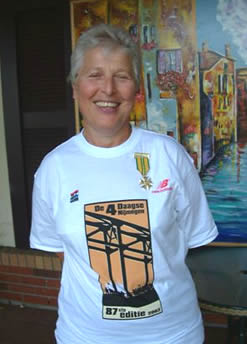
I am back from Holland and I have a few souvenirs of my participation with 44,000 other walkers from around the world in the 87th Annual International 4-Day walk in Nijmegen –the largest event of its kind. As you may have read in an article in The Oakville Beaver, those souvenirs include not just a medal and diploma but the memory of a full-heel blister and the loss of four toenails which are now growing back in nicely.
|
One of the vital lessons I learned during the walk was the importance of mental preparation. When I embarked on this adventure, I spent a lot of time on physical training – the right shoes, building up endurance - while underestimating the importance of mental training as well. On the first day, about 3 kilometres before the end, I was ready to cry and give up because I was so sore from a blister caused by walking with a brace required because of an earlier injury. (I tore ligaments in February while training in Oakville and then re-injured the same foot again in May.) The first two days of the walk took place in one of the most severe heat waves Europe has experienced in years: 35 Celsius – or 95 F on the first day and 43C - over 100 F on the second day. For just the second time in its history, event organizers allowed the 50K and 40K walkers to reduce their distance by 10 kilometres and allowed 30K walkers, such as myself, an extra half hour to finish. More than 4,400 walkers dropped out. By the end of the four days Red Cross had treated 12,000 for blisters using 8 kilometres of bandage tape and 80 litres of iodine. My two brothers who, as members of the Canadian military, had completed the walk years ago – had impressed upon me the importance of changing socks every two hours. On the first day I had to use all my willpower to forge ahead, helped by my daughter, Tina, who came along as my coach. The second day – the one on which most walkers drop out – was the worst. There was no shade and the temperature was 100-plus. We started out walking 10K to the Red Cross tent where we were delayed for two hours waiting for my blister treatment with 300 others. Tina and I set out virtually alone after that delay. We managed to complete the 22 kilometres in four hours but the heat was so unbearable and in order to make up lost time, we had to cover the distance in three and a half hours, struggling along on a painful foot. Tina repeatedly urged me to not focus on the pain, but rather on finishing our goal. Three kilometres from the end I hit ‘the wall’ and I wanted to give up. Casting about for a method of battling pain and fatigue, I began projecting images of my friends onto trees and fixtures ahead – calling out to them to urge me on. It worked and I am eternally grateful to them. We were the last stragglers and by the time we reached the final half-kilometre hundreds of party-goers had begun to block the roadway making it difficult to find the walk signs. Tina had to pull me through the crowds who would have preferred her to stop and join the party. Still, we made it and punched in my bar code with 3 minutes to spare before I would have been disqualified. All we could do was cry with happiness. That day reinforced the importance of maintaining a balance in your electrolytes and choosing proper foods to avoid hitting the wall. On the physical training side, I found that diverse training such as cycling helps to stretch those calf muscles, preventing spasms. The third day – which everyone had said would be the most difficult - was a breeze for us. Temperatures were lower and we trekked through a lot of beautiful forest area. My daughter wore my pedometer but forgot her stride is much longer than mine. When we hit what we thought was 5 kilometres to go, I borrowed a chair from one of the spectators, changed my socks and had an energy bar. Resuming, we saw a sign held by a spectator which said “500 metres to go.” What a cruel joke, my daughter said. But it turned out to be true. We had walked the 30 kilometres (with lots of breaks) in 7 hours. The fourth day was one of happy anticipation as we completed the walk, making our way with thousands of walkers through throngs of cheering spectators (some on rooftops) who lined the streets for the last 6 kilometres. If you are at all claustrophobic – like I am - being swamped in these crowds at the finish can require all your mental strength to get through. My bar code went through with plenty of time to spare. After receiving my medal, my daughter and I rewarded ourselves with two large beers each and partied with a group of Dutch soldiers who were dancing and singing the Dutch songs – bringing back memories of my youth in Holland. |
|